Resistive Touch Drivers
|
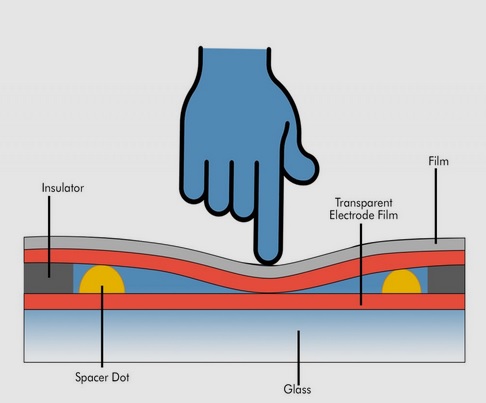
Resistive touch is a pressure-sensitive screen technology using two flexible, conductive layers separated by spacers; when pressed, the layers touch, changing electrical resistance to register a touch point, allowing input from fingers, gloves, or styluses, making it durable and cost-effective for industrial/medical use but less clear and gesture-friendly than capacitive screens.
How it works:
- Layers: Two transparent sheets (often Indium Tin Oxide (ITO) coated) are stacked, with small insulating dots (spacers) between them.
- Pressure: Applying pressure (with a finger, stylus, glove) deforms the top layer.
- Contact: The top layer touches the bottom layer at the point of pressure, completing an electrical circuit.
- Detection: The screen's controller measures the change in electrical resistance to determine the X and Y coordinates of the touch.
Key characteristics:
- Input: Works with any object (finger, glove, stylus, tool).
- Durability: Good for rugged environments.
- Cost: Generally lower cost.
- Clarity: Poorer image clarity due to multiple layers.
- Multi-touch: Does not support multi-touch gestures (pinch, zoom).
- Applications: Industrial control, medical devices, POS systems, kiosks.
|

|
Created with the Personal Edition of HelpNDoc: 5 Reasons Why a Help Authoring Tool is Better than Microsoft Word for Documentation