Ptr8, Ptr16, Ptr24, Ptr32
Syntax
Variable = Ptr8 (Address) Variable = Ptr16 (Address) Variable = Ptr24 (Address) Variable = Ptr32 (Address)
or
Ptr8 (Address) = Variable Ptr16 (Address) = Variable Ptr24 (Address) = Variable Ptr32 (Address) = Variable
Overview
Indirectly address RAM for loading or retrieving using a variable to hold the 16-bit address on enhanced 14-bit core devices and 18F devices.
Parameters
Variable is a user defined variable that holds the result of the indirectly address RAM area, or the variable to place into the indirectly addressed RAM area. Address can be a Word, Long, or Dword variable or expression that holds the 16-bit address of the RAM area of interest.
Address can also post or pre increment or decrement:
(MyAddress++) Post increment MyAddress after retrieving it’s RAM location. (MyAddress --) Post decrement MyAddress after retrieving it’s RAM location. (++MyAddress) Pre increment MyAddress before retrieving it’s RAM location. (--MyAddress) Pre decrement MyAddress before retrieving it’s RAM location.
Ptr8 will load or retrieve a value with an optional 8-bit post or pre increment or decrement. Ptr16 will load or retrieve a value with an optional 16-bit post or pre increment or decrement. Ptr24 will load or retrieve a value with an optional 24-bit post or pre increment or decrement. Ptr32 will load or retrieve a value with an optional 32-bit post or pre increment or decrement.
8-bit Example.
' Load and Read 8-bit values indirectly from/to RAM
'
  Device = 18F25K20                    ' Choose an 18F device
  Declare Xtal = 16          ' Tell the compiler the device is operating at 16MHz

  Declare Hserial_Baud = 9600           ' Set Baud rate to 9600

  Dim MyByteArray[20] As Byte           ' Create a byte array
  Dim MyByte As Byte                    ' Create a byte variable
  Dim bIndex As Byte
  Dim wAddress as Word                  ' Create a variable to hold address
Main:
'
' Load into RAM
'
  wAddress = AddressOf(MyByteArray)  ' Load wAddress with address of array
  For bIndex = 19 To 0 Step -1       ' Create a loop
     Ptr8(wAddress++) = bIndex        ' Load RAM with address post increment
  Next
'
' Read from RAM
'
  wAddress = AddressOf(MyByteArray)  ' Load wAddress with address of array
  Do                                  ' Create a loop
     MyByte = Ptr8(wAddress++)        ' Retrieve from RAM with post increment
     HRsout Dec MyByte, 13            ' Transmit the byte read from RAM
     If MyByte = 0 Then Break         ' Exit when a null(0) is read from RAM
  Loop
16-bit Example.
' Load and Read 16-bit values indirectly from/to RAM
'
  Device = 18F25K20                 ' Choose an 18F device
  Declare Xtal = 16          ' Tell the compiler the device is operating at 16MHz

  Declare Hserial_Baud = 9600         ' Set Baud rate to 9600 for HRsoutLn

  Dim MyWordArray[20] As Word        ' Create a word array
  Dim MyWord As Word                 ' Create a word variable
  Dim bIndex As Byte
   Dim wAddress as Word               ' Create a variable to hold the address

Main:
'
' Load into RAM
'
  wAddress = AddressOf(MyWordArray)  ' Load wAddress with address of array
  For bIndex = 19 To 0 Step -1      ' Create a loop
     Ptr16(wAddress++) = bIndex       ' Load RAM with address post increment
  Next
'
' Read from RAM
'
  wAddress = AddressOf(MyWordArray)  ' Load wAddress with address of array
  Do                                  ' Create a loop
     MyWord = Ptr16(wAddress++)       ' Retrieve from RAM with post increment
     HRsout Dec MyWord, 13            ' Transmit the word read from RAM
     If MyWord = 0 Then Break         ' Exit when a null(0) is read from RAM
  Loop
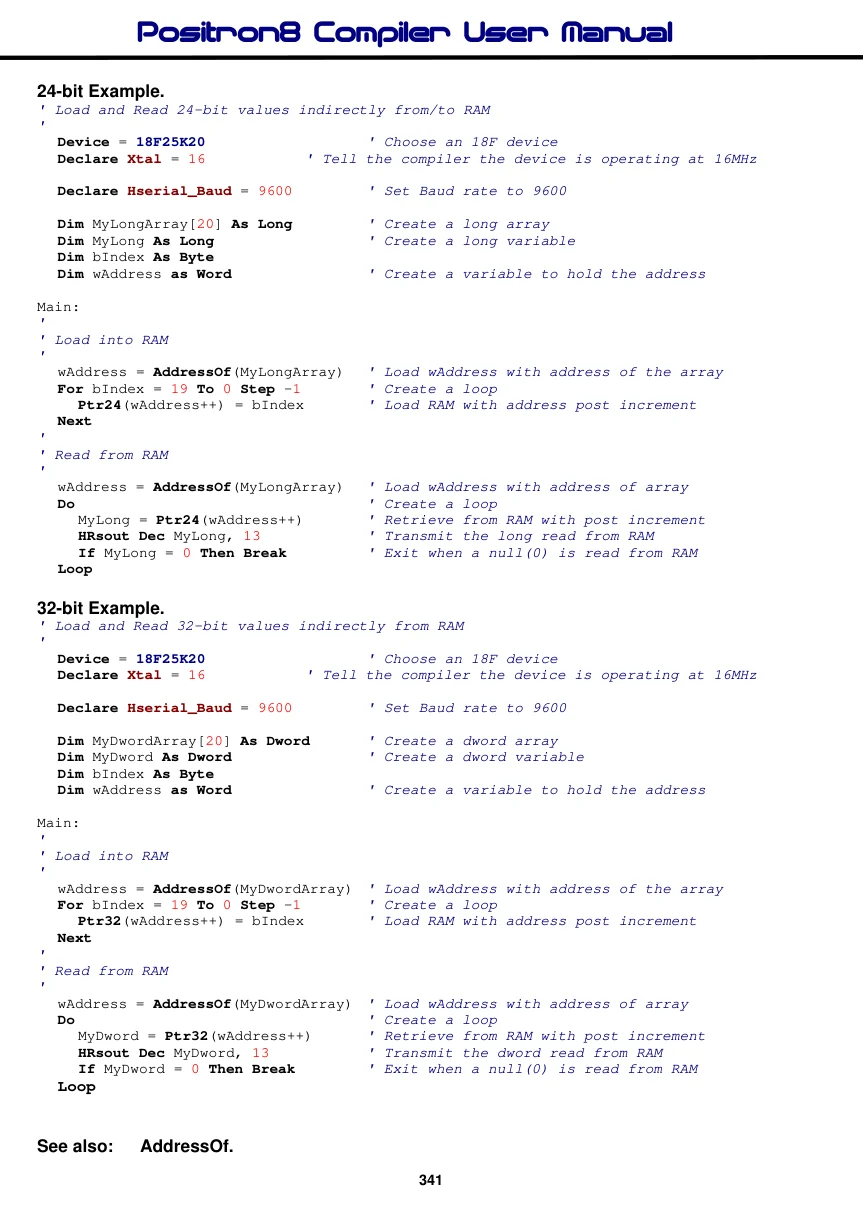
24-bit Example.
' Load and Read 24-bit values indirectly from/to RAM
'
  Device = 18F25K20                 ' Choose an 18F device
  Declare Xtal = 16          ' Tell the compiler the device is operating at 16MHz

  Declare Hserial_Baud = 9600         ' Set Baud rate to 9600

  Dim MyLongArray[20] As Long        ' Create a long array
  Dim MyLong As Long                 ' Create a long variable
  Dim bIndex As Byte
   Dim wAddress as Word               ' Create a variable to hold the address

Main:
'
' Load into RAM
'
  wAddress = AddressOf(MyLongArray)  ' Load wAddress with address of the array
  For bIndex = 19 To 0 Step -1      ' Create a loop
     Ptr24(wAddress++) = bIndex       ' Load RAM with address post increment
  Next
'
' Read from RAM
'
  wAddress = AddressOf(MyLongArray)  ' Load wAddress with address of array
  Do                                  ' Create a loop
     MyLong = Ptr24(wAddress++)       ' Retrieve from RAM with post increment
     HRsout Dec MyLong, 13            ' Transmit the long read from RAM
     If MyLong = 0 Then Break         ' Exit when a null(0) is read from RAM
  Loop
32-bit Example.
' Load and Read 32-bit values indirectly from RAM
'
  Device = 18F25K20                   ' Choose an 18F device
  Declare Xtal = 16          ' Tell the compiler the device is operating at 16MHz

  Declare Hserial_Baud = 9600         ' Set Baud rate to 9600

  Dim MyDwordArray[20] As Dword      ' Create a dword array
  Dim MyDword As Dword               ' Create a dword variable
  Dim bIndex As Byte
  Dim wAddress as Word               ' Create a variable to hold the address

Main:
'
' Load into RAM
'
  wAddress = AddressOf(MyDwordArray)  ' Load wAddress with address of the array
  For bIndex = 19 To 0 Step -1        ' Create a loop
     Ptr32(wAddress++) = bIndex       ' Load RAM with address post increment
  Next
'
' Read from RAM
'
  wAddress = AddressOf(MyDwordArray)  ' Load wAddress with address of array
  Do                                  ' Create a loop
     MyDword = Ptr32(wAddress++)      ' Retrieve from RAM with post increment
     HRsout Dec MyDword, 13           ' Transmit the dword read from RAM
     If MyDword = 0 Then Break        ' Exit when a null(0) is read from RAM
 Loop
See also: AddressOf.